-
PSSM1 Polysaccharide Storage Myopathy Type 1
About the Test The PSSM1 DNA test verifies the presence of the affected allele at the GYS1 locus responsible for Polysaccharide Storage Myopathy Type 1 (PSSM1). Sample Collection Hair Roots: 20 to 30 hair roots. Pull the hair and tape it onto the printable sample submission form. Blood Sample: 5 mL blood in a K3 EDTA tube. Collect the blood and send the tube together with the printable sample submission form. Turnaround Time Standard Processing: Results in 5 working days after sample arrival at the laboratory. Clients organize and cover the costs of sending the samples. Why Test? This genetic test helps breeders identify horses carrying the PSSM allele. Informed breeding choices can prevent the birth of affected foals. While PSSM cannot be cured, muscle function can be managed with dietary changes and exercise routines. The PSSM1 test is required by many studbooks and is highly recommended when considering the purchase of a horse. Testing for PSSM1 as part of the pre-purchase examination can ensure that you are making an informed decision, as the condition can impact the horse's performance and overall health. Learn More Results Description The DNA test results will be one of the following: n/n: Negative for PSSM1. No affected allele present. n/P1: Positive heterozygous for PSSM1. One mutated allele present. The horse can pass the PSSM1 allele to 50% of its progeny. P1/P1: Positive homozygous for PSSM1. Two mutated alleles present. The horse will pass the PSSM1 allele to 100% of its offspring. Additional Information Polysaccharide Storage Myopathy (PSSM1) is a hereditary muscle disease that affects many breeds. The condition is caused by a mutation in the GYS1 gene, leading to an abnormal accumulation of glycogen in the muscles. This can cause symptoms such as muscle tremors, stiffness, reluctance to move, and excessive sweating. Management of PSSM1 includes dietary changes and regular exercise to help mitigate symptoms. Check our FAQs for more information FAQs What breeds are affected by PSSM1? PSSM1 affects many breeds, including Quarter Horses, Belgian Draft Horses, and Warmbloods. The prevalence of the mutation varies by breed, with some breeds having a higher incidence of the condition. How is PSSM1 inherited? PSSM1 is inherited in an autosomal dominant manner, meaning that horses with one (n/P1) or two (P1/P1) copies of the mutated gene can develop the disease. Horses with two copies generally show more severe symptoms. How can PSSM1 be managed? Management includes dietary modifications to reduce starch and sugar intake, and a consistent exercise regimen. These measures can help prevent the onset of symptoms or reduce their severity. Visit our full FAQ page for more details.
€43.05
-
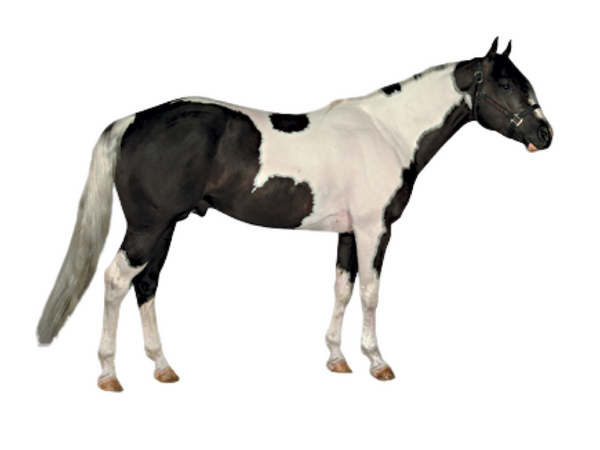
Tobiano coat pattern
DNA test The DNA test verifies the presence of the chromosomal inversion. The Tobiano coat pattern usually involves some white on all four legs and rounded white spots on the body with sharp, clean edges. Sample 30 to 40 - hair roots - envelope or 5 mL - blood - K3 EDTA tube Turnaround time 2 to 5 working days Why test? This genetic test can confirm is the horse is heterozygous (To/N) or homozygous (To/) for the Tobiano gene. For breeding purposes, homozygous Tobiano horses are highly desirable as they are guaranteed to produce Tobiano foals regardless of their mate. Since Tobiano is only responsible for the white markings of a so called “colored” horse, the test does not determine the horse’s base-color. This is determined using the extension test. The two tests in conjunction not only verify the likelihood of Tobiano being passed to foals, but also the likelihood the foals will be piebald or skewbald. Results description The DNA test verifies the presence of the chromosomal inversion and presents results as one of the following: N/ – Non-tobiano horse. To/N – Positive for the dominant Tobiano gene mutation, carrier of a single inherited copy of Tobiano. Horse’s base color may be modified to varying degrees by the Tobiano markings. To/ – Positive for dominant Tobiano gene mutation, carrying two inherited copies of Tobiano. Will always pass Tobiano to foals. For breeding purposes, homozygous Tobiano horses are highly desirable as they are guaranteed to produce Tobiano foals regardless of their mate. Additional information The Tobiano coat pattern usually involves some white on all four legs and rounded white spots on the body with sharp, clean edges. The head of the horse is usually colored and will not have white caused by the Tobiano gene. The white on the body will generally cross the top-line of the horse. Although white often incorrectly referred to as adding color it is actually a deletion of color. Tobiano is the result of a chromosomal inversion, affecting regulatory regions of the KIT gene. The Tobiano coat pattern is governed by the dominant KIT gene. Only one copy of Tobiano gene (To/N) is required to express Tobiano coat pattern. Homozygosity of the Tobiano gene (To/) may show visual clues (“ink spots” or “paw prints”) but only genetic testing will tell you more conclusively that the horse is homozygous for the Tobiano gene. When there is no presence of the Tobiano gene (N), the Tobiano coat pattern is not possible.
€43.05
-
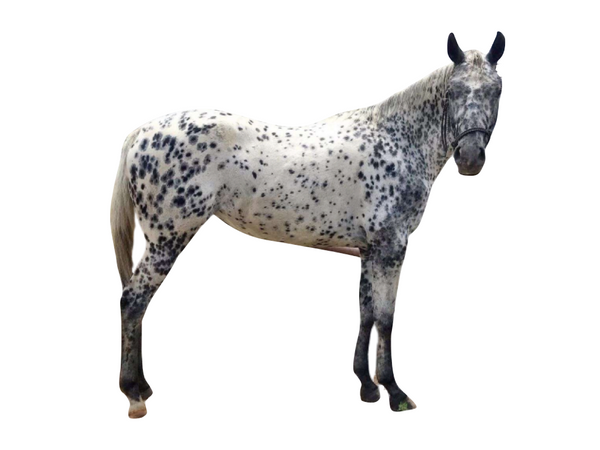
PATN1 - coat pattern spotting
DNA test The DNA test verifies the presence of the dominant (PATN1) mutation. Sample 20 to 30 - hair roots - envelope or 5 mL - blood - K3 EDTA tube Turnaround time 2 to 5 working days Results description The DNA test verifies the presence of the dominant (PATN1) mutation and presents results as one of the following: N/ - Negative for PATN1. Absence of the dominante PATN1 gene - non spotted horse. PATN1/N - Positive heterozygous for PATN1 (Dominant). Presence of one copy of the dominant PATN1 gene responsible spotted coat. The horse can pass the PATN1 variant to 50% of their progeny when bred. PATN1/ - Positive homozygous for PATN1 (Dominant). Presence of two copies of the dominant PATN1 gene responsible for spotted coat. The horse will pass the PATN1 gene to 100% of its offspring. Additional information
€43.05
-
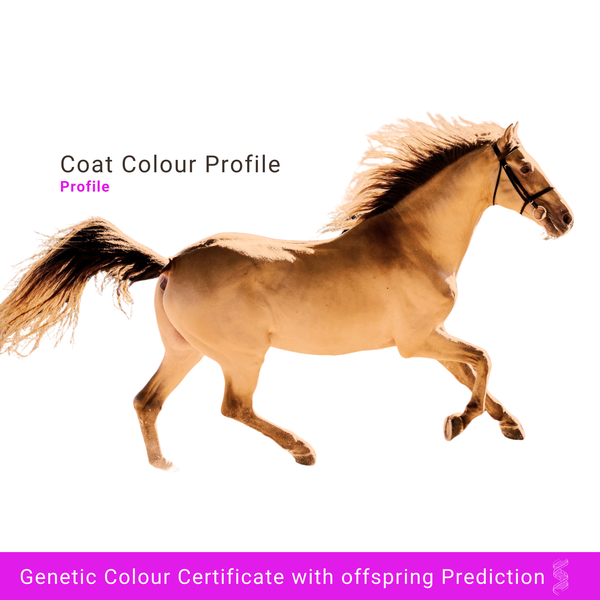
Coat colour profile
8 panel genetic test for coat colour with results in 5 to 10 working days. Includes 8 coat colour genetic markers: 2 base colour - Agouti, Extension; 5 dilutions - Cream, Pearl, Champagne, Silver and Dun (D, nd1, nd2) and the Grey* (G/G, G/N or N/N) depigmentation gene. Our Grey test in panels provide the number of copies of the Grey gene (G/G, G/N, N/N) A Genetic Colour Certificate - Coat Genotype and Offspring Prediction of coat colour is provided Sample type: 30 to 40 hair roots or 5 mL of blood (K3 EDTA tube) Turnaround time 5 to 10 working days Additional information DNA tests for coats can be an important tool for selection, elimination of coat-related diseases and enhancing your stud farm. There are various coat colours and tones in the horse species. Judging coat colour by eye is always subjective and can be influenced by a number of environmental factors (light exposure, time of year and feeding) and it doesn’t allow us to predict with any confidence that the “colour” will be passed down. Genetic determination of coat colour can be done correctly in a laboratory using DNA tests. This method allows us to determine with rigour and objectivity the horse´s coat colour and also forecast the potential transmission of “colour” to offspring. Currently more than 16 gene variants have been identified that can influence this phenotypic characteristic.
€184.50
-
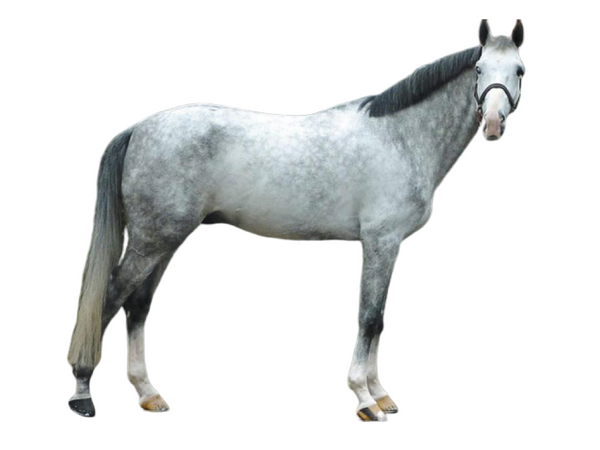
Grey depigmentation
DNA test The DNA test verifies the presence of the grey mutation. Grey is the dominant gene responsible for the gradual and progressive de-pigmentation (fading) of the carrying horse. Sample 5 mL - blood - K3 EDTA tube Turnaround time 2 to 5 working days Why test? This genetic test can help breeders that are interested in specifically breeding grey foals. Homozygous grey specimens are ideal as they will always transmit the grey gene when bred, thus guaranteeing eventual grey progeny. For the breeder that wants to “breed-out” the grey modifier to gain non-fading foals may hope for heterozygous grey horses. Some breed-types have a large percentage of grey stock which through historical lineage may harbour colours and dilutions that are ‘hidden’ by the masking effect of the grey. Insight into a foal’s potential to fade: since grey may cause slow de-pigmentation, it may not be visually apparent whether or not a newborn foal will eventually fade to grey. The de-pigmentation process may take many years and therefore DNA testing is useful in the cases whereby a foal is born of one or more grey parents and verification of the presence of grey is necessary. Results description The DNA test verifies the presence of the grey mutation and presents results as one of the following: N/ – Non-grey horse. Negative for grey. Horse will not turn grey. G/N - Grey horse. Positive for dominant grey gene, carrying a single inherited copy. Carrier’s coat modified and will eventually become de-pigmented. Heterozygous grey horses are statistically likely to pass the gene to 50% off their progeny when bred. G/ - Grey horse. Positive for dominant grey gene, carrying two inherited copies. Carrier’s coat modified and will eventually become de-pigmented. Homozygous grey horses are genetically bound to pass the gene to 100% of their progeny when bred, so all foals will receive grey and fade-out. Additional information Grey is the dominant gene responsible for the gradual and progressive de-pigmentation (fading) of the carrying horse. Grey cannot be considered a base-color, or a dilution, but rather a gene which slowly removes pigment from the coat. This gene is considered to be the ‘strongest’ of all coat modifiers, and acts upon any base-color regardless of the carrying horse’s phenotype. The fading process itself may last for years, but once hair is de-pigmented, the horse’s original colouring will never return. Since grey is a dominant gene, where it is present it is expressed. However, the final phenotype of the carrier will vary from horse to horse. Some grey horses fade to full de-pigmentation (almost pure white) whereas others may be ‘fleabitten’. Fleabitten refers to grey horses with tiny non-faded spots or ‘fleabites.’ The grey carrying horse may also experience de-pigmentation of the skin itself, and before skin is fully faded may display ‘mottling’. Equine melanomas occur most often in grey horses, and it is expected that at least 80% of grey horses will develop melanoma.
€49.20
-
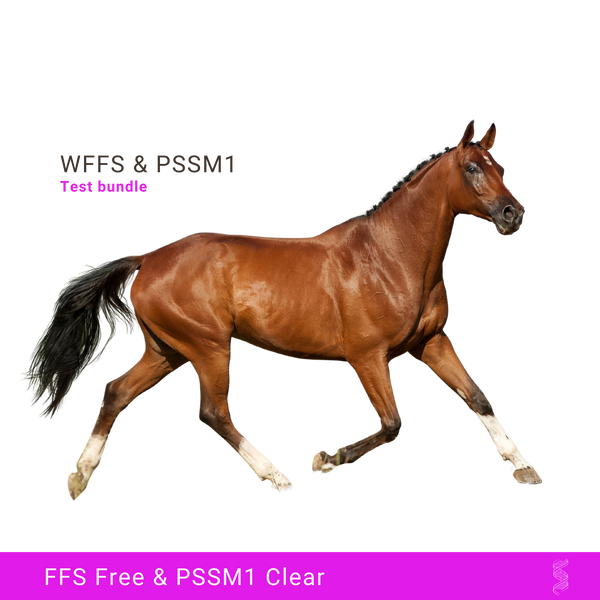
WFFS/FFS & PSSM1 - DNA Test bundle
DNA Test Bundle: PSSM1 & WFFS Discover Peace of Mind with Precision Equine Genetics. Our DNA test bundle offers a comprehensive genetic screening for Polysaccharide Storage Myopathy Type 1 (PSSM1) and Warmblood Fragile Foal Syndrome (WFFS), empowering you with essential information for the wellbeing of your equine companion. Tests Included PSSM1 Genetic Test: Uncover the presence of the specific allele at the GYS1 locus responsible for PSSM1, a condition affecting muscle metabolism in horses. Early detection can guide management and care. Learn more about the PSSM1 test here. WFFS Genetic Test: This test identifies the allele at the PLOD1 locus responsible for Warmblood Fragile Foal Syndrome (WFFS). Knowing your horse's genetic status aids in making informed breeding decisions. Further details on the WFFS test can be found here. Sample Collection 20-30 hair roots. Tape the hair to the printable sample submission form. Alternatively, 5 mL blood in an EDTA tube. Send the tube with the printable sample submission form. Turnaround Time Standard Processing: Results in 5 working days after sample arrival at the laboratory. Clients organize and cover the costs of sending the samples. Premium Processing: Results in 2 working days after sample arrival. This service includes free express delivery. For an additional fee of €35, the laboratory arranges express shipping with package pick-up from your address (available for non-remote regions). For premium processing, please contact the laboratory at support@equigerminal.pt for further assistance. Why Test? This genetic test helps breeders identify horses carrying the PSSM1 and WFFS alleles. Informed breeding choices can prevent the birth of affected foals. While PSSM1 affects muscle metabolism, WFFS is a fatal connective tissue disorder. Testing for these conditions is often required by studbooks and is highly recommended during pre-purchase exams to ensure the horse's health and performance. Learn More Results Description The DNA test results will be one of the following: PSSM1 n/n: Negative for PSSM1. No affected allele present. PSSM1 n/P1: Positive heterozygous for PSSM1. One mutated allele present. The horse can pass the PSSM1 allele to 50% of its progeny. PSSM1 P1/P1: Positive homozygous for PSSM1. Two mutated alleles present. The horse will pass the PSSM1 allele to 100% of its offspring. WFFS n/n: Negative for WFFS. No affected allele present. WFFS n/WFFS: Carrier for WFFS. One copy of the mutated allele present. The horse can pass the WFFS allele to 50% of its progeny. WFFS WFFS/WFFS: Positive for WFFS. Two copies of the mutated allele present. The foal will exhibit severe clinical signs and must be euthanized shortly after birth due to the untreatable nature of the disease. Such foals will not survive to adulthood and hence will not pass on the allele. Additional Information Polysaccharide Storage Myopathy (PSSM1) is a hereditary muscle disease affecting many breeds, caused by a mutation in the GYS1 gene. Warmblood Fragile Foal Syndrome (WFFS) is a fatal genetic defect of connective tissue, resulting from a mutation in the PLOD1 gene. WFFS is characterized by hyperextensible, fragile skin and mucous membranes, leading to severe lesions and often resulting in euthanasia of affected foals shortly after birth. Both conditions can significantly impact a horse's health and performance, making genetic testing an essential tool for breeders and buyers. References Ablondi, M., et al. (2022). Performance of Swedish Warmblood fragile foal syndrome carriers and breeding prospects. Genet Sel Evol 54, 4.Rowe, Á., et al. (2021). Warmblood fragile foal syndrome causative single nucleotide polymorphism frequency in horses in Ireland. Ir Vet J 74, 27.Dias, N. M., et al. (2019). Dias, N. M., et al. (2019). Warmblood Fragile Foal Syndrome causative single nucleotide polymorphism frequency in Warmblood horses in Brazil. Vet J 248, 101–102.Hoelzle, L., et al. (2020). Distribution of the Warmblood Fragile Foal Syndrome Type 1 Mutation (PLOD1 c.2032G>A) in Different Horse Breeds from Europe and the United States. Genes 11(12), 1518. Check our FAQs for more information FAQs What breeds are affected by PSSM1 and WFFS? PSSM1 affects many breeds, including Quarter Horses, Belgian Draft Horses, and Warmbloods. WFFS primarily affects Warmbloods but has also been detected in breeds like Thoroughbreds, Knabstruppers, Haflingers, and American Sport Ponies. How are PSSM1 and WFFS inherited? PSSM1 is inherited in an autosomal dominant manner, meaning horses with one (n/P1) or two (P1/P1) copies of the mutated gene can develop the disease. WFFS is inherited as an autosomal recessive trait, requiring two copies of the mutated gene (WFFS/WFFS) for the disease to manifest. Affected foals with two copies of the WFFS mutation will not survive to adulthood and must be euthanized shortly after birth. How can PSSM1 and WFFS be managed? PSSM1 management includes dietary modifications to reduce starch and sugar intake, and a consistent exercise regimen. WFFS, however, is a lethal condition with no cure, emphasizing the importance of genetic testing to inform breeding decisions and avoid producing affected foals. Visit our full FAQ page for more details.
€73.80
-
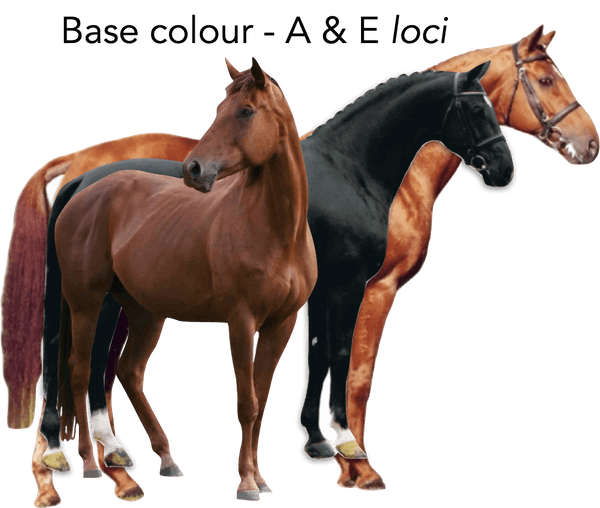
Base colour test - A and E loci
Buy a Base colour test and find out if your horse's base colour is Black, Bay or Chestnut. Results within 24 h are available. DNA test for the Agouti and Extension loci that controls distribution of Black and Red pigment throughout the coat. Sample 30 to 40 hair roots or 5 mL - blood - K3 EDTA tube Turnaround time Standard processing - Results in 3-5 working days after sample arrival at the laboratory. Clients organize and support the costs of sending the samples to the laboratory. PREMIUM processing - Results in 1 day after sample arrival. Includes free express delivery** . The laboratory organizes Express shipping with pick-up of the package at the client's address and delivery at the laboratory. ** PREMIUM SERVICES INCLUDE AN EXPRESS SHIPPING DELIVERY FOR EUROPEAN COUNTRIES FROM NON-REMOTE REGIONS. Check here to know if you are in a remote European region. For remote/outreach regions EXTRA fees are applied. Why test? Horses have only three base colours: Bay, Black or Chestnut These different colours are controlled by 2 loci, the Extension (Red/Black) and Agouti. The Extension locus controls the production of black or red pigment throughout the coat. The allele for black color (E) is dominant over the red allele (e), so a horse only needs one copy of the black allele to appear black-based. But if the horse has two alleles (e/e) he will appear Chestnut. The Agouti locus can then modify black pigment by pushing it the horse's points, creating a Bay. The Agouti A allele is dominant, so a black pigmented horse only needs one copy (heterozygous) of the A allele to appear Bay. The Agouti (a) allelle is recessive, thus, a horse needs two copies (homozygous) of the recessive allele (a) at the Agouti locus to appear Black. Agouti has no effect on red pigment, but the red allele (e) is dominant over the (a) allele. This means a Chestnut horse (e/e) can carry one or two copies of the Agouti recessive (a) allele and will look no different from chestnut horses with Agouti dominant alleles (e/e a/a, e/e A/a, e/e A/A). Results description Base Colour Extension Agouti Bay E/E or E/e A/A or A/a Black E/E or E/e a/a Red e/e A/A, A/a or a/a References Rieder, S., Taourit, S., Mariat, D., Langlois, B., & Guérin, G. (2001). Mutations in the agouti (ASIP), the extension (MC1R), and the brown (TYRP1) loci and their association to coat color phenotypes in horses (Equus caballus). Mammalian genome : official journal of the International Mammalian Genome Society, 12(6), 450–455. https://doi.org/10.1007/s003350020017 Marklund, L., Moller, M. J., Sandberg, K., & Andersson, L. (1996). A missense mutation in the gene for melanocyte-stimulating hormone receptor (MC1R) is associated with the chestnut coat color in horses. Mammalian genome : official journal of the International Mammalian Genome Society, 7(12), 895–899. https://doi.org/10.1007/s003359900264
€61.50 - €95.00
-
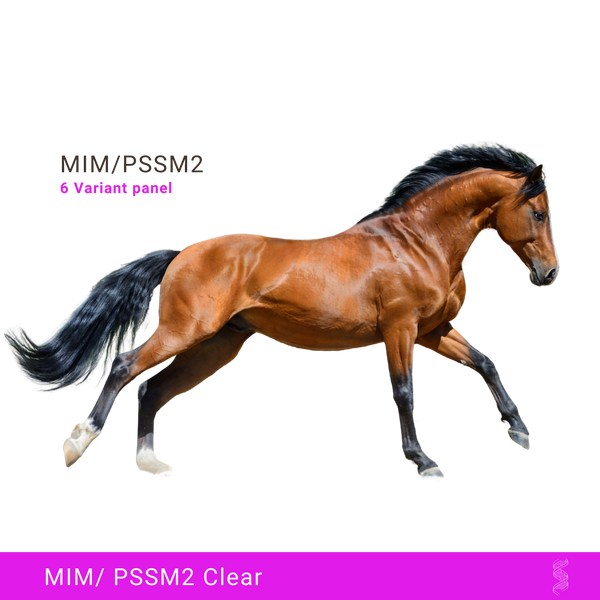
Generatio MIM (PSSM2) DNA Test - 6 variant panel
MIM (PSSM2) DNA Test Ensure the Health and Performance of Your Horses with Accurate MIM Testing. Our DNA test identifies the presence of genetic variants associated with Muscle Integrity Myopathy (MIM), formerly known as PSSM2, which affects muscle function and structure. Sample Requirements 30 to 40 hair roots - envelope Alternatively, 5 mL blood - K3 EDTA tube Turnaround Time up to 15 working days Results Description The DNA test identifies six genetic variants that predispose horses to developing symptoms of Muscle Integrity Myopathy: P2: Myotilinopathy P3: Filaminopathy P4: Myozenin-3-Myopathy P8: PYROXD1-Myopathy Px: CACNA2D3-Myopathy K1: COL6A3-Myopathy Genetic Inheritance Muscle Integrity Myopathy (MIM) is caused by a hereditary predisposition involving multiple genetic variants. These variants disrupt the structure and function of muscle fibers, leading to symptoms such as muscle stiffness, unexplained lameness, and difficulty building muscle. Clinical Signs and Affected Breeds Symptoms of MIM can vary widely among horses and include unexplained lameness, muscle stiffness, difficulty with gait changes, reluctance to move, muscle atrophy, and behavioral changes. Almost any breed can be affected, with common occurrences in breeds like Quarter Horses, Warmbloods, and Thoroughbreds. Why Test? Testing for MIM is crucial for breeders and owners to make informed decisions. By identifying carriers of the genetic variants, breeding choices can be optimized to prevent the spread of these disorders. Additionally, knowing a horse's genetic status can help manage and mitigate symptoms through tailored exercise and feeding protocols. Learn More Detailed Results Description The DNA test results will indicate the presence of the following genetic variants: P2: Myotilinopathy P3: Filaminopathy P4: Myozenin-3-Myopathy P8: PYROXD1-Myopathy Px: CACNA2D3-Myopathy K1: COL6A3-Myopathy Additional Information Muscle Integrity Myopathy (MIM) is a genetic disorder that disrupts muscle function and structure, leading to various clinical signs. While it is not possible to cure genetic disorders, optimized management through diet and exercise can help mitigate symptoms, allowing horses to lead normal lives. References Generatio. Muscle Integrity Myopathy in HorsesEquiSeq. Polysaccharide Storage Myopathy type 2 (PSSM2) Check our FAQs for more information FAQs What breeds are affected by MIM? Almost any breed can be affected by MIM, with common occurrences in breeds like Quarter Horses, Warmbloods, and Thoroughbreds. How is MIM inherited? MIM is caused by multiple genetic variants that disrupt muscle structure and function. These variants are inherited and can predispose horses to developing symptoms of exertional myopathy. How can MIM be managed? While genetic disorders cannot be cured, their symptoms can often be managed through optimized feeding and exercise protocols. Identifying genetic variants through testing allows for tailored management strategies to mitigate symptoms. Visit our full FAQ page for more details.
€357.32
-
HERDA Hereditary Equine Regional Dermal Asthenia
DNA test DNA test for Hereditary Equine Regional Dermal Asthenia (HERDA). This test verifies the presence of the recessive HERDA gene. Sample 30 to 40 - hair roots - envelope or 5 mL - blood - K3 EDTA tube Turnaround time 2 to 5 working days Why test? This DNA test helps breeders to identify horses that carrying the HERDA recessive mutation. Informed choices can be made for breeding selections, and prevent the born of affected foals. Results description The DNA test verifies the presence of the recessive HERDA gene and presents results as one of the following: N/ - Negative for HERDA. Absence of the defective gene responsible for HERDA. N/HERDA - Carrier - Positive heterozygous for HERDA. Presence of one copy of the allele responsible for HERDA. The horse is a carrier for HERDA and can pass on a copy of HERDA allele to their progeny when bred. HERDA/ - Positive Homozygous for HERDA. Presence of two copies of the allele responsible for HERDA. The horse is affected by HERDA disorder and can pass the HERDA allele to 100% of their progeny when bred. Additional information Hereditary equine regional dermal asthenia (HERDA) is a genetic skin disease predominantly found in the American Quarter Horse. Within the breed, the disease is prevalent in particular lines of cutting horses. HERDA is characterised by hyper-extensible skin, scarring, and severe lesions along the back of affected horses. Affected foals rarely show symptoms at birth. The condition typically occurs by the age of two, most notably when the horse is first being broke to saddle. There is no cure, and the majority of diagnosed horses are euthanised because they are unable to be ridden and are inappropriate for future breeding. HERDA has an autosomal recessive mode of inheritance and affects stallions and mares in equal proportions.
€43.05
-
Melanoma
DNA test 2 DNA tests that can help to predict the possible type of incidence for developing dermal melanomas on grey horses. Sample 5 mL - blood - K3 EDTA tube Turnaround time 2 to 5 working days Why test? This 2 DNA tests for melanoma confirms if the grey horse is heterozygous (G/N) or homozygous (G/) for the Grey gene and if is Homozygous for non-agouti (a/a).The results can predict the type incidence for developing dermal melanomas. Results description The genetic profile test verifies the genotype of the Grey and Agouti genes, and presents results as one of the following: Melanoma incidence risk G/N + A/a or A/A – Moderate incidence of dermal melanomas. G/N + a/a – Moderate to high incidence of dermal melanomas. G/G + A/a or A/A – High incidence of dermal melanomas. G/G + a/a – Very high incidence of dermal melanomas. Additional information Most melanomas found in horses are benign. Once present these benign types of melanoma are not aggressive in their growth and may progress over several years requiring little treatment. A melanoma is one of the most common skin tumors seen in a horse or pony. Grey horses have a high incidence of dermal melanomas that are commonly seen around the tail and head. Over 80% of Grey horses older than 15 years will develop melanoma. Grey homozygotes are more likely to develop melanoma than heterozygotes. Grey horses that are homozygous for non-agouti (aa) genotype at the Agouti locus, also have a higher risk for melanoma. Many Grey horses show depigmentation of the skin around the eyes, mouth and anus but there are no health risks associated with this condition. Malignant melanomas in horses can cause severe problems and can be life-threatening. Problems develop when melanomas are present internally or if they become so large that they ulcerate, bleed and become infected. Equine melanomas sometimes grow so large that they can cause severe weight loss and/or colic. If a melanoma is situated on the head in an area where a bridle, saddle, head collar or rug might rub, it will be uncomfortable for the horse, potentially causing behavioural problems. Infections can also occur.
€73.80
-
Cream dilution
DNA test The cream dilution gene has varying effects on different base colours. To obtain the exact ‘type name’ of cream dilute of the horse it is recommended to run this test in conjunction with Extension and Agouti genes. Sample 30 to 40 - hair roots - envelope or 5 mL - blood - K3 EDTA tube Turnaround time 2 to 5 working days Why test? Testing is useful where genetic confirmation is required or to define cream dilute horses aside from other genes with similar effects (such as champagne dilution and grey). Running this test will confirm if a horse is cream dilute. As mentioned the cream dilution gene has varying effects on different base colours. To obtain the exact ‘type name’ of cream dilute of the horse (eg. Buckskin, Palomino, Cremello…) it is recommended to run this test in conjunction with red factor and agouti. Results description The DNA test verifies the presence of the Cream dilution gene and presents results as one of the following: N/ - Non-dilute. Basic colours are black, bay or chestnut, in the absence of other modifying genes. N/Cr – Dilute. Heterozygous, one copy of the Cream (Cr) allele. Chestnut is diluted to palomino; bay is diluted to buckskin and black is diluted to smoky black. These colours can be further modified by the actions of other genes. Cr/ - Double dilute, two copies of the Cream (Cr) allele. Chestnut is diluted to cremello; bay is diluted to perlino and black is diluted to smoky cream. Additional information The cream dilution gene affects both red and black pigment and is responsible for ‘diluting’ the carrying horse to lighter coat shades and colours. In many breeds this is often considered a highly desirable trait. Cream dilution is the gene responsible for palominos, buckskins, cremellos and many more. Horses which carry one copy of the cream gene are identified as single dilutes; they are heterozygous for the cream dilution gene. In the simplest case, a bay horse with a single copy of cream is known as a buckskin, a single dilute black horse is known as a smoky black and a single dilute chestnut or sorrel horse is known as a palomino. Single dilute horses have a 50% chance on passing the cream gene on to its offspring. Horses which carry two copies of the cream gene are referred to as double dilutes; they are homozygous for the cream dilution gene. A bay horse with two copies of cream is known as a perlino. A black horse with two copies of cream is known as a smoky cream and a chestnut or sorrel horse that carries two copies of cream is known as a cremello. Double dilute horses will always pass on a copy of the cream gene to its foals.
€43.05
-
HYPP Hyperkalemic Periodic Paralysis
DNA test for the Hyperkalemic Periodic Paralysis Disease (HYPP). This DNA test verifies the presence of the recessive HYPP gene. Sample requirements 30 to 40 hair roots or 5 mL of blood in K3 EDTA tube Turnaround time 2 to 5 working days Why test? This genetic test helps breeders to identify horses that carrying the HYPP recessive gene. Informed choices can be made for breeding selections, and prevent the born of affected foals. All offspring of Impressive should be tested for HYPP. Because HYPP is dominant disorder, the effects of it can also be transposed to other breeds of horses when intermixing occurs. This test is important in preserving the inherited health of all horses. Horses with suspicious symptoms of the disease should also be tested. Results description The DNA test verifies the presence of the recessive HYPP gene and presents results as one of the following: N/ – Normal - Absence of the allele responsible for HYPP. N/H – Affected - Positive heterozygous for HYPP. Presence of one copy of the allele responsible for HYPP. The horse is affected with the HYPP disorder and there is a 50% chance this horse will pass a HYPP allele to its offspring. H/ – Affected- Positive homozygous for HYPP. Presence of two copies of the allele responsible for HYPP. The horse is affected with the HYPP disorder and there is a 100% chance this horse will pass a HYPP allele to its offspring. Additional information Hyperkalemic Periodic paralysis (HYPP) is an inherited disease of the muscle, which is caused by an inherited genetic mutation. A point mutation in DNA exists in the sodium channel gene, which codes for an abnormal channel to be expressed in skeletal muscle. This mutation is passed on to offspring. Sodium channels are “pores” in the muscle cell membrane which control contraction of the muscle fibers. When the defective sodium channel gene is present, the channel becomes “leaky” and makes the muscle overly excitable and contract involuntarily. The channel become “leaky” when potassium levels fluctuate in the blood. This may occur with fasting followed by consumption of a high potassium feed such as alfalfa. Hyperkalemia, which is an excessive amount of potassium in the blood, causes the muscles in the horse to contract more readily than normal. This makes the horse susceptible to sporadic episodes of muscle tremors or paralysis. Severity of attacks varies from unnoticeable to collapse or sudden death. The cause of death is usually respiratory failure and/or cardiac arrest. This genetic defect has been identified in offspring of the American Quarter Horse sire, Impressive. To date, confirmed cases of HYPP have been restricted to descendants of this horse. HYPP is a dominant disorder meaning both homozygous positive (HH) and heterozygous (nH) horses will be affected. Only homozygous negative (nn) horses are not affected by HYPP.
€43.05